Showing posts with label Liver transplant. Show all posts

Wednesday, August 6, 2014

World Organ Donation Day....Be an organ donor, wipe tears from many a eye

We make a living by what we get, but we make a life by what we GIVE

One donor can save as many as 9 lives


If you had the ability to save 9 lives...wouldn't you?


 After brain-death, organs like heart, lungs, intestines, pancreas, liver and kidneys as well as tissues like cornea of the eye, blood vessels, bones, tendons can be donated to save or improve the lives of many others. Immediately after the heart has stopped beating in certain situations the kidneys and liver can be rapidly harvested and used for transplantation. However beyond a few minutes after the heart stops beating,only  tissues can  be used for donation.

In India, donation after heart stops beating (donation after cardiac death ) has not yet been introduced for multiple reasons. The law allows organ retrieval from brain dead (but heart beating) donors and living related donors.

There is a massive shortage of donor organs in India
Organ donation rate in India is among the lowest in the world standing at 0.08 donations per million deaths as compared to 10-30 per million deaths seen in most parts of the western world. A single organ donor can provide a liver, two kidneys, intestine, pancreas, heart, two lungs that can potentially save the lives of nine others who are suffering from failure of their own organs. In addition sight of two blind persons can be restored. Tissues such as bone, tendons and skin from a single donor can be used to restore function and improve life of several people. As a result of this, the nearly 70 lakh Indian patients with corneal blindness, 3 lakh with dialysis dependent renal failure and 1 lakh with advanced liver disease need nothing short of a miracle to happen in order to get a cornea, kidney or liver from a brain dead (deceased donor). 

Major hurdles in organ donation
Legal
Social
Procedural

Legal hurdles
The Human Organ Transplant Act passed by parliament in 1995 has been passed by most state assemblies. The law has performed commendably in streamlining the process of organ donation, brain death declaration and significantly reducing if not eliminating the ghastly organ trade. However certain well-meaning but probably ill conceived rules have inadvertently prevented organ donation from really taking off. The recently introduced amendments would probably help increase the facilitation when they are in effect.
Prominent among the hurdles are:
For organ harvesting to be performed the hospital where the donor is must only be a transplant center or a registered non-transplant retrieval centre

Brain death declaration required certification by four doctors one of whom must be a neurologist or neurosurgeon

The person in charge of the body (next of kin) has to consent for donation to proceed even if it overrules the brain-dead persons expressed living intention in the form or donor card or living will.

This excludes a large number of hospitals with ICUs and potentially brain dead donors from offering organs for donation. As a result less than 10% potential organ donors in India end up donating organs as opposed to more than 25% in the rest of the world.

Social
The social, cultural and religious issues are myriad. 

Despite most religions teachings
 having no major objections to organ donation, most families decline donation on religious grounds based on misconceptions that a person without organs will not be allowed in heaven or a person who is not buried or cremated with all organs will be reborn without those organs.

Religious teachings & organ donation
Steeped in  traditions and illiteracy, many sections of society find it difficult to accept that their loved one whose heart is still beating is actually not with them anymore. Added to this dangerous mix is a motley crew of community elders, village panchayats and ill informed practitioners of traditional medicine who parochially impose their views on the family of the brain-dead patient offering unrealistic hopes that their patient will miraculously recover from his irreversible coma. This often creates anger and a trust deficit between the brain-dead persons family and counselors who are perceived to be in pursuit of profit at the expense of the life of their loved one.

All the above however pales in front of the rank indifference and apathy shown by medical professionals towards the entire process of organ donation. In the absence of motivation from being a part of a transplant center, a majority of medical professions continue to manage patients with irreversible coma without broaching the subject of organ donation or a reluctant to discuss the issue with patient family citing fears of angry backlash from family members.An equal number of medical professionals themselves harbor numerous misconceptions and misgivings regarding organ donation. The medical education in India until recently had no inclusion of organ donation and brain death in its curriculum. 

Procedural 
 In a survey it was estimated that there has been a 51% increase in unnatural deaths in the decade 2002-2012. Nearly 32.6 accidental occur in India per 100,000 population. In 2012-2013 there were nearly 4,00,000 accidental deaths of which more than 94% were unnatural. nearly 42% of these occur following rail or road traffic accidents. Out of all accidental deaths, approximately 10-15% are due to irreversible injury to brain. Therefor at current estimates, there are between 30000-40000 potential candidates for donation after brain death amongst accidental deaths annually. However less than 500 donations happen across the country in any given year.

Ignoring the legal and social hurdles for a moment, this has not only a lot to do with poor trauma and transport services for maintaining these victims till they reach hospital but also to red-tapism, tedious and laborious paperwork and alarming apathy on part of investigating officers, forensic experts and other agencies in allowing organ donation to proceed in the brain dead individual is a victim in a crime or accident scene.

All is not lost...through tireless campaigning by several individuals, organisations and agencies of governments who have awakened albeit belatedly to the issue, the organ donation rate has nearly quadrupled over the last 10 years. There is a lot of distance to be covered. At a mere 1-2 donations per million deaths, this country can meet its transplant needs so that nobody with organ failure has to die waiting for an organ.

The medical fraternity should lead by example by pledging their organs and encouraging their friends and family to register to be donors. 

At my center, to commemorate World Organ Donation Day, we took a pledge to donate all our usable organs after our death and to work to encourage our friends and family towards registering themselves as organ donors.


"We, the doctors and staff of Continental Hospital, on the occasion of World Organ Donation Day, hereby unconditionally pledge to donate all our usable organs and tissues following our death to save the lives of others. We take this pledge in the presence of the almighty and our soul as our witnesses.
We also swear to work towards educating our families and friends about organ donation and also to encourage them to be organ donors and give the gift of life to others after they are gone"


Organ donation logo


Pledge board signing
 
I invite and urge all readers to join this movement with a poem I penned sometime ago

Your body is but a shrine
That envelops your soul
A gift from your maker
To help discharge your earthly role

When it's time and end is nigh
Your soul readies to depart
The body, it's shell
Free from your essence
Is but a wilted flower
Devoid of fragrance

Consigned to flames or ceremonially buried
To tune of hymns, chants and litanies varied
Into wasteful ashes or earth shall return
All precious body parts turn by turn
Many a heart, kidneys and liver
In needy others which could still deliver


Arise, its never too early to make the choice
Gift your organs after you've left
Save many lives that remain bereft
Wipe tears from many a eye
That's the only way to leave this world on a high!


Tuesday, July 29, 2014

Liver Metastasis (Secondary liver cancer): is it the end of the road?

Liver metastasis (Secondary liver cancer) is not the end of the road in the era of modern liver surgery & transplantation

Cancer deposits within the liver from a site outside the liver are called liver metastases or secondary liver cancers. In fact more than 50% cancers in the liver do not originate in the liver cells but are metastasis from other sites.

Liver is the third commonest site for development of secondary deposits from cancer anywhere in the body. For cancers originating in the stomach, intestine, pancreas, gallbladder/bile duct, colon and rectum; it is the second commonest site after local lymph nodes.

Why is the liver a common site for liver metastasis?


The liver receives blood from the arterial system like other organs and tissues. Additionally nutrient rich blood from the gastrointestinal tract also enters the liver through the portal vein. This dual blood supply exposes the liver to greater risk of receiving circulating tumor cells from cancers anywhere in the body.

The microscopic structure of the liver is unique. it has blood spaces called sinusoids that have lining like blood vessels; but with with gaps in between the adjacent cells. This allows cancer cells that arrive via blood to slip outside the wall into the liver substance more easily than in other organs.

The sinusoids described above are also lined by special immune cells called Kupffer cells that specialise in extraction of abnormal cells and proteins from the blood flowing in the sinusoids. Kupffer cells also extract cancer cells arriving via blood which helps them gain access to the liver.

Metastasis is fortunately an inefficient process!

Fortunately, metastasis is not an efficient process. Less than one in a million cells that reach the liver would develop into metastasis.
Once cells arrive in the liver they usually remain dormant in the absence of conducive environment for them to grow by stimulating factors or factors that enable them to received extra blood and nutrients that help them grow rapidly into metastasis. In certain cancers like breast cancer, the cancer releases factors in the blood that creates sites called pre-metastatic niches within the liver where , if the cancer cells reach, they have higher chances of developing into metastasis.
Cancer cells that come out of dormancy become cell clusters called micro-metastasis. Micrometastasis remain dormant within the liver unless they acquire potential to grown budding blood vessels (angiogenesis), which transforms them into metastatic deposits.

How many cancer patients develop liver metastasis?

As a result of improvement in survival for most cancers, cancer patients are surviving significantly longer for the last three decades than earlier.Advances in radiological techniques have increases the sensitivity of detection of liver metastasis than conventional techniques. In particular metabolic imaging like FDG-PET scanning has increased detecttion of metastasis by more than 25% in most cancers.

It is believed that more than 30% cancer patients will have liver metastasis detected during their lifetime and if autopsy is performed for all patients dying of cancer, 65% would have metastasis in the liver. Importantly in 15-30% of these patients, liver is the only site of metastatic deposits.

More than 30% of patients with cancer in colon and rectum have liver metastasis when the cancer is first detected (synchronous) and more than 70% develop liver metastasis after treatment of their colonic or rectal cancer (metachronous).

Liver metastasis is the end of the road....myth or fact?

Traditionally the detection of liver metastasis has been considered the end of the road for many years. Barring liver metastasis from slow growing and indolent neuroendocrine tumours, patients with liver metastasis are likely survive less than 2 years after diagnosis.

In the modern era of multidisciplinary cancer management, systemic chemotherapy has become more effective, safe and molecular targets within cancer cells have been identified in some cancers for specific non-cytotoxic targeted therapy. With these advances, survival even after detection for liver metastasis has progressively improved but yet long term survival (>5yrs) has been unachievable by this modality alone for most cancers. However chemotherapy alone cannot cure liver metastasis unless all cancer cells are conlusively shown to be killed within the metastasis. Sadly more than 50% liver metastasis that show reduction in size or completely disappear on scans (ghost lesions), have viable tumor cells under the microscope.

With improvements in technology, safe anaesthesia practices, better imaging and greater experience in liver surgery, the procedure has become safer and is regularly being performed with near 0% mortality.Liver surgery has been therefore increasingly applied to metastatic liver disease in the hope that removal of liver metastasis would help in prolonging survival. Despite good safety profile, long term survival with surgery alone has also been disappointing. Surgery is unable to treat micrometastasis, circulating tumor cells and dormant cells because they cannot be detected on current imaging modalities...therefore systemic therapy has to be married to surgery when treating liver metastasis for most patients if long term survival is to be achieved.

With greater experience, combination of systemic therapy and surgery has been introduced for management of liver metastasis with much better outcomes over the last 15 years with survival exceeding 50% at 5 years for liver metastasis from colon, rectum, breast, ovary/testis, neuroendocrine cancer using peri-operative systemic therapy and surgery in selected patients.

All over the world, surgeons haveperformed liver transplantation for patients with large metastasis from slow growing neuroendocrine tumors that are not amenable to excision, with good results (even better than for hepatocellular carcinoma) and this is accepted universally. One of the most famous recipients of a liver transplant for such metastasis was late Steve jobs of Apple.

Recently a group from Norway showed excellent results after liver transplantation for liver metastasis from colorectal cancer and the idea is evoking interest all over Europe. However this is yet to gain acceptability elsewhere.

A perusal of published literature on liver surgery for liver metastasis brings forth the following points
  1. Liver resection, if safely performed, to remove all existing liver metastases is useful for all cancers
  2. Patients should be selected based on medical fitness, extent of tumor in liver & experience of treating team
  3. It must be part of multidisciplinary strategy that includes systemic therapy & interventional radiology
  4. Best survival is obtained after complete excision of liver metastasis is obtained if the metastases are few in number, confined to the liver, if the metastasis are sensitive to chemotherapy and appear many years after the primary tumour has been treated.
Therefore in the modern era, in selected patients, liver metastasis is definitely not the end of the road. This statement is particularly true for patients with liver metastasis from cancer of the colon or rectum, neuroendocrine tumors, breast cancer, testicular & ovarian cancer and gastrointestinal stromal tumors (GIST).

All patients with liver metastasis benefit from liver directed therapy, choosing the appropriate therapy and at the right time is important for optimum outcome.


Sunday, July 27, 2014

World Hepatitis Day 2014: Hepatitis is closer than you think....think again


Hepatitis....know it...confront it

Hepatitis is a term used for inflammation of the liver cells due to any cause

Causes of hepatitis
  1. Viruses: hepatitis viruses A-H, non-hepatitis viruses: herpes, cytomegalovirus etc
  2. Bacteria
  3. Parasites
  4. Drugs
  5. Chemicals & toxins including alcohol
It can manifest in two forms

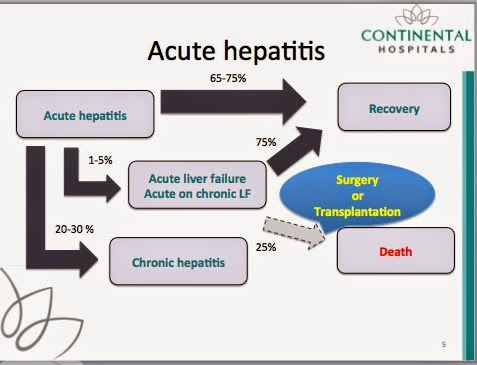
Acute hepatitis
Recurrent hepatitis
Chronic hepatitis

Common routes of transmission of hepatitis are through contaminated food and drink (feco-oral route), through blood & blood products (parenteral route) and sexual contact.

Transmission through placental circulation from pregnant infected mother to child in the womb is called vertical transmission.

Acute hepatitis is characterised by abdominal discomfort, low-moderate grade fever, nausea, lethargy and loss of appetite. Most viral infections are associated with feeling of uneasiness, weakness, body pain before development of jaundice (prodrome). Jaundice is the hallmark of acute hepatitis and is usually detected by yellow discolouration of eyes and passage of dark yellow urine. Liver function tests show raised bilirubin level (mainly conjugated) accompanied by elevated liver enzymes (AST, ALT and frequently ALP). Urine shows elevated bile salts. Massive elevation of enzymes >1500 IU is rare. High fever usually indicates concurrent inflammation within the biliary system (cholangitis).

Acute hepatitis is a self-limiting disease and in most cases with supportive care, complete uneventful recovery results over a period of a few weeks. Recovery may be prolonged in elderly patients, pregnant women, those receiving medication to reduce immunity or those who have pre-existing liver damage from alcohol, fatty liver or other causes.

Alcoholic hepatitis is a unique form of hepatitis that occurs after years of large consumption of alcohol. It usually follows a binge of alcohol but can occasionally seen in early phases of abstinence. 
It is a severe form of hepatitis that causes a systemic inflammatory state often associated with infection, kidney dysfunction and progression to liver failure. The underlying liver is usually pre-cirrhotic or frankly cirrhotic in patients with alcoholic hepatitis. Many patients with alcoholic hepatitis have muscle wasting and nutritional defects making them prone to infections and multi organ failure leading to significant mortality despite supportive care.

In less than 5% cases, the liver damage caused by inflammation overwhelms the body immunity and the capacity of the liver to repair and regenerate. In such situations patients may progressively and rapidly develop cardinal features of liver failure : Deep jaundice  Mental changes (Encephalopathy & Clotting dysfunction. This syndrome is called Acute liver failure if patient had normal liver to start with and Acute on chronic liver failure if patient has a recognised or unrecognised chronic liver disease to start with.

Both are very severe conditions and if condition does not respond to medical measures, can be fatal.

Chronic hepatitis is usually the result of persistent or recurrent damage or the failure of immunity to clear the acute infection or insult. Chronic hepatitis is seen in 20-30% most of which is due to hepatitis B or C virus infections. Common hepatitis virus A is never chronic while less common hepatitis can rarely cause chronic infection.

Chronic hepatitis can follow an indolent course being asymptomatic for years before detection. Until liver damage has exceeded the reserve of the liver, liver function tests may be normal apart from subtle alterations.

The chronic inflammation in the liver can lead to development of primary liver cancer ( hepatocellular carcinoma) in unto 4% patients with chronic hepatitis every year.

Chronic inflammation can also lead to progressive scarring and changes in the micro architecture  of the liver leading to fibrosis and eventually cirrhosis. Once cirrhosis develops, the average survival is less than 10 years in most cases. Progressive damage can lead to features of chronic liver failure like jaundice, accumulation of fluid in abdomen (ascites), clotting deficiency and mental changes (hepatic encephalopathy). Reduction in liver function reduces immunity leading to increased propensity for infections and strain on other organ systems. In such a state average survival is less than one year.

Once cirrhosis develops the risk for developing hepatocellular carcinoma doubles to 8% per year.

As in most diseases, prevention is better than cure

Prevention of hepatitis

  1. Consumption of safe food and drink
  2. Vaccination: hepatitis B, hepatitis A
  3. Avoid alcohol & IV drug abuse
  4. Avoid unprotected high-risk sexual activity
  5. Avoid contaminated syringes, needles, blood and blood products
  6. Manage body weight & keep diabetes in check

Early detection of hepatitis

  1. Periodic health checks
  2. Screening of high risk patients
    • children of parents with liver cancer or hepatitis
    • siblings & spouses of patients with liver cancer or hepatitis
    • patients receiving blood products (haemophiliacs, thalassemics) or dialysis
    • iv drug abuse history
    • high risk unprotected sexual activity & commercial sex workers
    • healthcare workers
    • patients with suppressed immunity or those on immunity reducing drugs

Treatment of hepatitis

  1. Most cases of acute hepatitis need only supportive care
  2. No specific treatment available for most viral hepatitis except hepatitis B and C
  3. Inciting cause should be detected, avoided and treated accordingly
  4. If acute or acute on chronic liver failure results patients should receive ICU management including ventilator support: some patients who don't respond can be salvaged by urgent liver transplantation
  5. Measures to prevent developing chronic hepatitis & cirrhosis should be taken
  6. Patients with chronic hepatitis should be aggressively followed for detection of cirrhosis or development of cancer
  7. Early cases of liver cancer can be cured by liver surgery if there is no cirrhosis. If thesre is cirrhosis, liver transplant is the best option
  8. Patients with complications of liver cirrhosis can be salvaged with liver transplant
  9. Measures to prevent recurrence of hepatitis should be instituted even after transplant

Monday, August 20, 2012

Liver transplantation for acute liver failure: look before you leap

Acute liver failure is a devastating syndrome leading to development of rapid development (within 26 weeks) of jaundice, coagulopathy and hepatic encephalopathy or coma in patients without history of liver disease. Acute liver failure is an medical emergency associated with significant healthcare costs, resource utilisation, morbidity and mortality. Even in the modern age, it carries a mortality of close to 30%. Successful management depends on early identification of cause and cause directed therapy, timely access to high level intensive care management and organ support and timely application of liver transplantation in those unlikely to respond or unresponsive to best medical care. Liver transplantation has single handedly improved survival in acute liver failure from less than 50% in the 1960-1980 to a respectable 70-75% after the 1990s.
To be effective and efficient, liver transplant should be performed "never too early but never too late". Early transplant deprives the patient from a chance of spontaneous recovery of liver function and exposes him (and even a family donor) to a needless risk and operation as well as condemns the patient unnecessarily to lifelong medication and immunosuppression with all the associated problems. Too late transplant reduces the chances of recovery and increases the morbidity and mortality of the procedure.
It is therefore critical to identify the window in which medical management does seem to be improving condition but before the onset of infection, cerebral oedema or multi-organ failure .
Reams have been written on how to identify this window and there is still some debate. Most clinicians utilise a combination of clinical and laboratory criteria in deciding which patients are unlikely to improve without liver transplantation. The criteria commonly used are the King's college criteria, MELD/PELD score or Clichy criteria. The parameters most often used to decide are the degree of encephalopathy, prothrombin time, bilirubin, arterial ammonia and lactate levels. In small children with rapid development of coma monitoring of intracranial pressure may help identify those that could recover after liver transplantation. It must be remembered that these criteria are not infallible and are at best 80-85% accurate in determining prognosis ie 10-15% patients who meet these criterial may still recover spontaneously without transplant.
From a patient's point of view, it is important not to panic but to ensure timely transfer to a liver transplant facility since transferring patients with severe encephalopathy who need ventilator can lead to acceleration of brain swelling and death. Liver dialysis though widely popularised about a decade ago, seems to do little more that allow patients to wait longer for transplantation although there are anecdotal reports of spontaneous recovery in drug or toxin induced conditions.
While time is of the essence, a mad rush in deciding regarding liver transplantation particularly for a living donor is never prudent. All attempts should be made to get all the information, even seek more opinions if needed. It is undoubtedly a gruelling decision and there is a lot of pressure all around but you must look before you leap!

Thursday, June 11, 2009

Who needs a liver transplant?

In acute liver failure most centres follow criteria proferred by King's College Hospital or Clichy criteria or local modifications thereof. Once these criteria are met, survival of the patient without early transplantation is unlikely.These criteria take into account the depth of coma,function of the liver, time between onset of jaundice and coma, age and cause of liver disease and renal function.

In chronic liver disease once a patient falls into Child's Turcotte Pugh category C ( based on bilirubin, albumin, ascites, prothrombin time prolongation and encephalopathy) or has MELD score > 14 ( based on blilirubin, creatinine and INR) transplantation should be considered.

While these are generally accepted, disease specific criteria are also applicable.